
Trade Access Partners

The first-shipment checklist

First machinery shipment to the UK: the compliance checklist

Seven steps with sources: EORI and importer of record, CE and UKCA paperwork, duty and trade remedies, insurance, arrival, preparation and what the first sale asks of you. Exporting machinery to the UK goes best for manufacturers who list the whole job early.

Last updated: August 2026

Book a market-entry assessment Read the UK market-entry guide

What do you need in place before your first machinery shipment to the UK?

Eight things, spread across the seven steps below: a GB EORI number, a named importer of record, a VAT position you understand, CE or UKCA conformity paperwork in order, the 10-digit commodity code checked for duty and trade remedies, insurance for transit, storage and product liability, somewhere to unload and prepare machines, and a plan for warranty and parts.

The order matters. Registrations and structure decisions gate everything that follows, so start at step one even if the vessel is already booked. Still weighing a distributor against an agent, a partner or a subsidiary? Settle that first in the UK market-entry guide, then come back here with the decision made.

This page is factual guidance with sources, not legal, tax or insurance advice. Where structure changes the answer, we say so: confirm those points with your advisers.

Before you ship: EORI, importer of record and VAT

Settle one question before anything else: who is the importer of record in the UK for this shipment? Incoterms decide the default. Sell DDP and you, the overseas seller, are the importer, which pulls a GB EORI number, indirect customs representation and UK VAT registration into your lap. Sell DAP or FCA and your UK buyer imports instead. There is no universal right answer, only a right answer for your structure, so take professional advice on this one early.

  • Importing into Great Britain needs a GB EORI number, whoever holds the job (GOV.UK, updated 7 Aug 2025).
  • A business not established in the UK can only make customs declarations through an indirect customs representative, who becomes jointly liable for the customs debt (GOV.UK, updated 21 Aug 2024). Expect them to vet you accordingly.
  • A non-established business making any taxable supplies in the UK must register for UK VAT with no threshold. The £90,000 threshold applies only to UK-established businesses (GOV.UK, updated 10 Oct 2024).
  • Import VAT runs at the standard rate of 20%. Postponed VAT Accounting, PVA, lets a UK-VAT-registered importer account for import VAT on the VAT return instead of paying it at the border (GOV.UK, updated 16 Jun 2025).

Get the structure wrong and every later step lands on the wrong desk. Get it right and the rest of this page is a sequence, not a scramble.

Sources: Get an EORI number, GOV.UK (updated 7 Aug 2025) · Customs representatives, GOV.UK (updated 21 Aug 2024) · Register for VAT, GOV.UK (updated 10 Oct 2024) · Accounting for import VAT on your VAT return, GOV.UK (updated 16 Jun 2025)

Product compliance: CE, UKCA and the paperwork in the crate

The marking question first, because it worries manufacturers more than it should. CE marking remains accepted in Great Britain indefinitely, alongside UKCA, for machinery under the Supply of Machinery (Safety) Regulations 2008 (GOV.UK, updated 7 Apr 2026). A compliant CE-marked machine does not need remarking for the GB market, and the government has confirmed that position holds as the EU's Machinery Regulation 2023/1230 replaces the Machinery Directive from 20 January 2027, with GB rules to be updated with comparable measures (GOV.UK, response published 25 Feb 2026).

What the 2008 Regulations actually ask: the machine meets the essential health and safety requirements, a Declaration of Conformity travels with each machine, a technical file sits behind it, and conformity is assessed, by self-declaration for most machinery (GOV.UK guidance, updated 24 Mar 2025). The technical file is what first shipments forget. Make sure you can produce it in full, and confirm your product category's detail with your advisers.

  • Northern Ireland is different: EU rules apply and CE marking is required, with UKNI added only where a UK notified body did the assessment (GOV.UK, updated 8 Apr 2026).
  • Engines: Stage V emission limits are retained in GB under the Non-Road Mobile Machinery (Type-Approval) Regulations 2018 (legislation.gov.uk). Engine approvals run through the VCA: confirm the detail with the VCA before you ship.
  • Outdoor equipment: the Noise Emission in the Environment by Equipment for use Outdoors Regulations 2001 require guaranteed sound-power, LWA, marking, and were amended with effect from 13 April 2026 to make CE recognition indefinite (GOV.UK, updated 13 Apr 2026).

Sources: Using the UKCA marking, GOV.UK (updated 7 Apr 2026) · Machinery safety legislation, government response, GOV.UK (25 Feb 2026) · Supply of Machinery (Safety) Regulations 2008 guidance, GOV.UK (updated 24 Mar 2025) · Using the UKNI marking, GOV.UK (updated 8 Apr 2026) · Non-Road Mobile Machinery (Type-Approval) Regulations 2018 · Noise Emission Regulations 2001 guidance, GOV.UK (updated 13 Apr 2026)

Duty and trade remedies: check the code before you price

You will notice this page quotes no duty rates. That is deliberate: rates change and generalisations cost money. Look up your machine's 10-digit commodity code on the UK Integrated Online Tariff before you price a single unit, and check it per model and per country of origin (trade-tariff.service.gov.uk).

Trade remedies are the trap for the unwary. An anti-dumping or countervailing measure on boom lifts originating in China was listed on 20 January 2026 (UK Integrated Online Tariff news). A measure like that can rewrite the economics of a product line overnight, so make the tariff check someone's named job, not a footnote.

Sources: UK Integrated Online Tariff · Anti-dumping or countervailing measure on boom lifts from China, UK Integrated Online Tariff (20 Jan 2026)

Halfway through the list and unsure who your importer of record should be? Book a market-entry assessment: you get a compliance snapshot for your product category and a recommended route, answered by a person who handles machinery for a living.

Insurance: transit, storage and the liability nobody prices in

Three covers, three conversations. First, marine transit cover from your factory gate to the UK warehouse, including the lifts at each end, where damage tends to happen. Second, storage cover for stock standing at the base, at values someone has actually checked against your current price list.

Third, and least discussed: product liability sized for the UK legal reality. Under section 2 of the Consumer Protection Act 1987, where the manufacturer is overseas, the importer of the product into the UK carries strict liability for defective products (legislation.gov.uk). Whoever takes the importer of record role in step one takes this with it. Brief your insurer and your advisers together, before the first container is booked, and put the certificates where your UK team can find them.

Sources: Consumer Protection Act 1987, section 2

Arrival: port, unloading and secure storage

Choose the port with your forwarder, not by habit. Container services, roll-on roll-off and breakbulk each land machinery differently, and the cheapest sea freight can buy the most expensive unload.

Book the unload before the vessel sails. Heavy machinery wants the right forks, the right slings and people who have done it before, plus a checking-in routine that photographs and records anything that travelled badly while a claim is still live. Then the stock needs somewhere secure and insured to stand. Worth knowing here: CESAR, the voluntary security marking and registration scheme for agricultural and construction equipment, owned by the Construction Equipment Association and recognised by police and insurers (cesarscheme.org). Receiving, unloading and machinery warehousing sit at the top of our services for exactly this reason.

Sources: CESAR scheme, Construction Equipment Association

Stacked shipping containers and gantry cranes at a container port
Arrival is a plan, not an event

Preparation: assembly, PDI and road registration

Two different jobs hide inside the word preparation. Assembly is the build: machines ship partly knocked down to save freight, so wheels, masts, cabs and attachments must be fitted and torqued to specification. Pre-delivery inspection, PDI, is the proof: fluids, settings, functions and safety devices checked against a written list before a customer ever touches the machine. Skip neither, and never let one hour cover both.

If the machine will use public roads, paperwork follows it. Vehicles used on public roads, including tractors and self-propelled machinery, must be registered with the DVLA and carry a V5C (GOV.UK, updated 23 Jan 2025). For agricultural tractors specifically, GB type approval currently runs on provisional arrangements based on EU approvals: confirm the current status with the VCA, and see our agricultural machinery notes for the sector detail.

Sources: Vehicle registration, GOV.UK (updated 23 Jan 2025) · GB type approval scheme, VCA

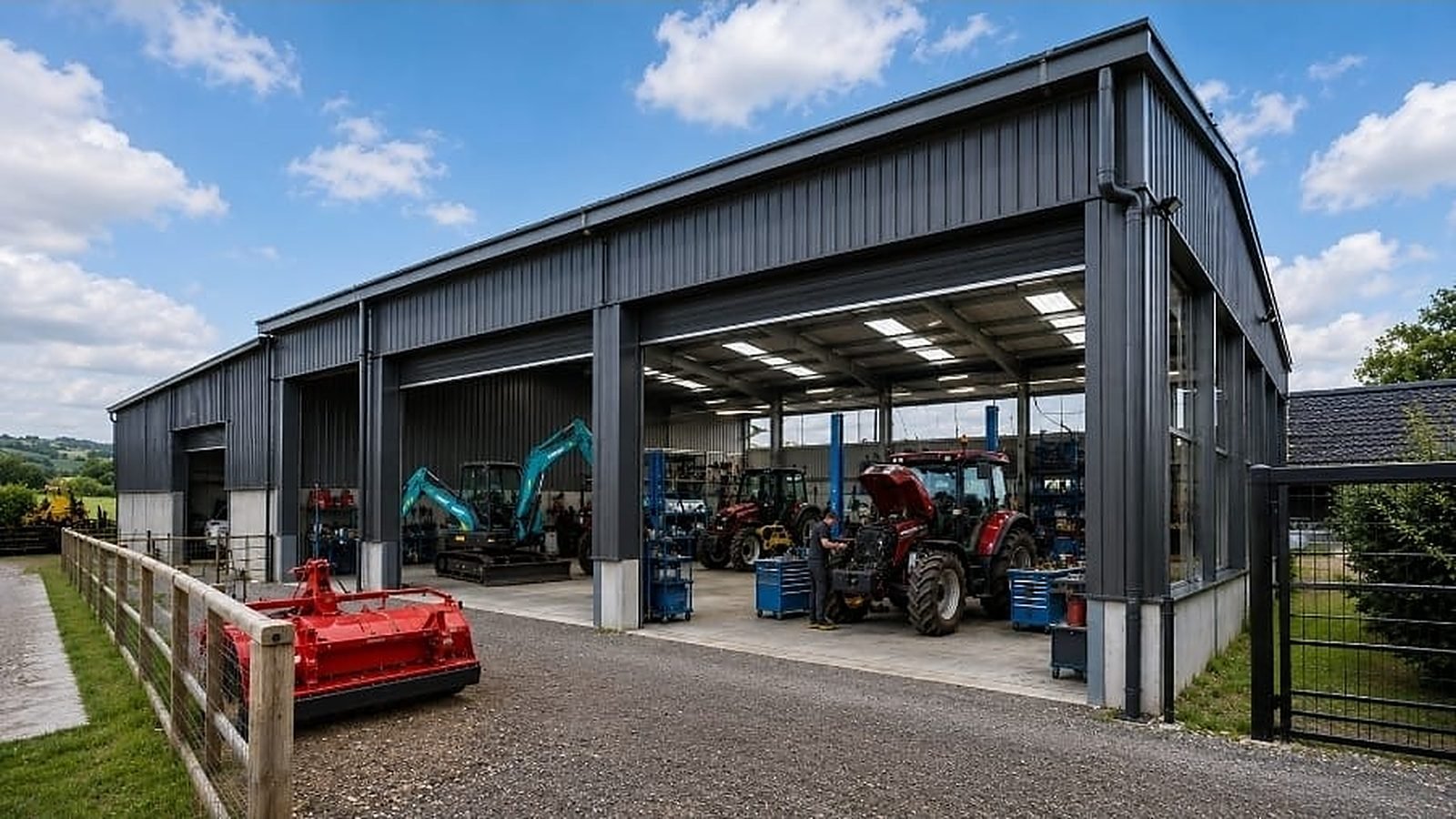
Machines under cover in the open bays at our base
Assembly and PDI: the hours between port and customer

After the first sale: warranty, parts and inspections

The first sale is where exporting to the UK stops being a shipping exercise. A machine down in season does not wait for a part to fly in from the factory, so decide before you sell: who answers the warranty call, who holds the fast-moving parts, who backs the dealer who backed you. How we staff that whole chain is set out in how it works.

  • Contract terms: business sales imply satisfactory quality and fitness for purpose under section 14 of the Sale of Goods Act 1979, and excluding those terms must pass the reasonableness test in the Unfair Contract Terms Act 1977 (legislation.gov.uk). Have your UK sale terms drafted properly.
  • Lifting equipment in service needs thorough examination by a competent person: six-monthly for lifting accessories and equipment that lifts people, twelve-monthly for other lifting equipment, or to an examination scheme (HSE). UK buyers will expect the certificates.
  • Electric machines carry producer duties: an importer placing electrical equipment on the UK market takes WEEE producer obligations, with registration and a compliance scheme at five tonnes or more a year (GOV.UK, updated 12 Aug 2025), and importers of industrial batteries carry producer obligations including free take-back (GOV.UK).
  • Packaging counts too: importers of packaged goods can be obligated under extended producer responsibility for packaging, with thresholds by turnover and packaging tonnage (GOV.UK, updated 11 Jun 2026).

Sources: Sale of Goods Act 1979, section 14 · Thorough examination of lifting equipment, HSE · EEE producer responsibility, GOV.UK (updated 12 Aug 2025) · Batteries and waste batteries regulations, GOV.UK · Extended producer responsibility for packaging, GOV.UK (updated 11 Jun 2026)

Questions

First shipment questions, answered straight

Who is the importer of record when exporting machinery to the UK?

Whoever your Incoterms and structure make it. Sell DDP and the overseas seller is the importer of record, which brings a GB EORI number, an indirect customs representative and UK VAT registration with it. Sell DAP or FCA and the UK buyer imports. A UK-established partner can also take the role. Confirm the shape with your advisers before booking the first container.

Is CE marking enough for Great Britain, or do we need UKCA?

CE marking remains accepted in Great Britain indefinitely, alongside UKCA, for machinery under the Supply of Machinery (Safety) Regulations 2008 (GOV.UK, updated 7 Apr 2026). Northern Ireland follows EU rules, so CE is required there. Either way, the Declaration of Conformity and technical file must be ready to produce.

Do we have to pay import VAT at the border?

Not necessarily. Import VAT runs at the standard rate of 20%, and Postponed VAT Accounting lets a UK-VAT-registered importer account for it on the VAT return instead of paying at the border (GOV.UK, updated 16 Jun 2025). Whether you register, and who imports, depends on your structure: confirm it with your advisers.

First shipments go wrong in the gaps between jobs, not in the jobs themselves. Book a market-entry assessment and get the whole sequence, from EORI to first warranty call, planned before the vessel is booked.

Sources: Using the UKCA marking, GOV.UK (updated 7 Apr 2026) · Accounting for import VAT on your VAT return, GOV.UK (updated 16 Jun 2025)

Start here, no commitment

Book your assessment

A short form. A reply from a real person.

We use your details to reply to this enquiry, nothing else. Full detail in our privacy policy.

Start here, no commitment

What would a credible UK start look like for your machines?